Thursday, April 24, 2014

¡Otra Vez!

On Wednesday, we started our day off with eggs and bread for breakfast at our host family's house.  Once we had finished eating, we walked to Yure's house for our literature class.  We began class by talking about José María Arguedas, the author of Los Ríos Profundos.  After discussing the biography and thoughts of Arguedas, we began our discussion of Los Ríos Profundos.  We then ate a delicious lunch of fish, potatoes, and vegetables at Yure's house.  

Beth reading with one of the girls:

Angie helping kids with homework:

Michael playing soccer with some of the boys:

We rested for a little bit, then walked to the orphanage, "El Centro de Atencion Residencial Juan Pablo II".  We have each been rotating between the various casitas each day.  Because some of the casitas are occasionally empty and because there are sometimes other volunteers there at the same time as us, Angie C. and I went to the same house.  We spent the afternoon playing, helping the children with their homework, and reading to the kids.  The casita we were in had not received their bag of donated supplies and toys, but we decided that we wouldn't bring the toys out until everyone had finished their homework.  I did, however, take out the book in the bag.  I read the story to a few different kids about thirty times.  They were so excited to have someone read to them and were very attentive for long periods of time.  The casita houses kids ranging in age from four to about ten.  The younger kids love to spend time with the volunteers, since they rarely get one-on-one attention.  For the most part, they were really well-behaved.  Dr. Shaw, Angie C., and I spent the whole afternoon just spending time with the kids.  We all wish we could adopt them.  We headed out at 5:00, meeting up with the rest of our class.  Michael had a lot of fun coloring a soccer ball with the flags of the various countries who will be competing in this year's World Cup and then playing soccer with some of the boys.  We all really enjoy our time with the kids and wish we could continue to visit for longer.  

The wood-fire oven used to cook our dinners:

Angie, Beth, and Dr. Shaw before dinner:

Amy, Angie, and Michael before dinner:

We headed back to our host family's house and played a couple of rounds of Strategy, the game Daniel taught us at one of the campsites during the trek.  We then walked to the San Blas Plaza for dinner at Pachapapa.  We were able to eat outside and all enjoyed our meals.  We then took a taxi (it was pretty crowded with 6 of us) back to Mery's house to eat a cake that was very similar to Angel Food Cake and drink tea, followed by a few more rounds of Strategy (I lost every round), which was enjoyed by everyone.  

Wednesday, April 23, 2014

The Day of Fruit

On Tuesday, we began our morning with a large fruit bowl of bananas, apples, papaya, oranges, and grapes covered with yogurt (and bread on the side of course) for breakfast. Our host mother, Mery, does an amazing job preparing breakfast for us every morning. After breakfast, we gathered our things and walked to Yuré's house for our daily literature class. This day's lesson focused on Jose Carlos Mariátegui and his varioius economic and political ideas concercing Peru. We had a very interesting discussion on his essays published in Siete Ensayos de la Interpretación de la Realidad Peruana.

After class, the women in Yuré's house prepared a delicious meal of spaghetti covered in beef and vegetable sauce. Everyone enjoyed the meal very much, and we finished with a bowl of bananas for dessert, and that wasn't the last of the fruit!

After lunch, we stopped by our homestay to pick up the toys we had brought for the children at the orphanage. When we brought them to the Director of the orphanage, she was ecstatic! We had a plethora of school supplies, stickers, play dough, stuffed animals, toy figurines, card games, and much more to donate. After sorting the items into piles to take to each home (casita) of at least 10 children, we each brought a bag of toys to the mothers of the homes. These mothers, the caretakers of the orphans, are absolutely incredible--they not only work at the orphanage for 12 ours each day, but have families of their own to support. For instance, one of the mothers, Timotea, has three children of her own, and she supports them by working as the head of the home of the oldest boys at the orphanage. It is touching to see these women care for the children at the orphanage as if they were their own. 

Anyway, we brought the bags of toys to the individual houses. Most of us had good luck distributing the toys or simply giving them all to the mother of the hosue. However, when I arrived at the house, the mother was not there, and a giant swarm of little hands attacked my bag of toys (and me). It was quite disorderly to say the least, as many of the children got a hold of all the toys in the bag. Thankfully, though, most of the children were happy with these gifts. Afterwards, we played with many of the kids on the playground--jumping rope, on the swings, playing volleyball, or simply running around. We all had so much fun and didn't want to leave!

Later on, after resting a bit, we attempted to go to a well known restaurant near the main plaza; however, it had changed into a different reaturant, so we improvised and went to Gustitos de Loli. This small restaurant had many different meat and pasta dishes. We got to try rich lamb, ravioles, and pork. The students finished the meal with a chooclate chip cookie, but we were all jealous of the strawberry dessert enjoyed by Doctor Shaw. She had the right idea: to end the day just how we started it--with fruit!

A photo of the outside of the Orphanage:

Angie with her lamb dinner:

Angie, Doctor Shaw, and Beth with their lamb dinners:

Mike, Angie, and Amy with their ravioli and pork dinners:


"¿Cómo te llamas?": First Day of Literature Class and the Orphanage

Today's breakfast consisted of panqueques (pancakes) with a kind of caramel-looking sauce and fresh orange juice. What a way to start our day of "firsts". We, then, walked to the infamous "Calle de José Carlos Mariátegui" where Yure's house is located. It is here that we began our first class on Mariátegui's Siete Ensayos. It is only fitting that we talk about him on the street named after him. We explored his ideas about how cultural conflict influences the Peruvian economy.


Lunch was delicious as always here at Yure's house. We had a large plate of spaghetti! It was just the meal we needed before venturing over to the orphanage to meet the energetic children.

Today we visited a local orphanage, Centro de Atención Residential Juan Pablo II. This was the first of many afternoons teaching and playing with children of all ages and personalities.


We were each assigned to a Casita (little apartment) which had about 10 children each. From the moment we walked through the doors of the casita (little apartment), the children latched onto us. All they needed to do was ask one question: "¿Cómo te llamas?" ("What is your name?"). Other questions came later, but none repeated as much as this one. 

The orphanage is not the only one in Cusco, but it is the only one of its kind. The children range from 6 months to 15 years old. They live in 5 casitas. Each casita has a "mamá" that looks after them. These women come from a variety of backgrounds. Either they never married or have been divorced. All of these mothers, no matter their background, are focused on providing a caring environment for the children. Most of the mothers are there because they do not have a family of their own; however, who could ask for a better community than the one established at the orphanage.


The children can be adopted by foreigners as well as locals through the normal adoption process. After today, I have no doubt that many of us wished we could bring them home. 

While with the children, we helped them with a variety of tasks, whether it was homework problems or getting plenty of air on the swings. In Michael's case, the children were allowed to go the park after they had finished their homework. One girl still had not finished and the rest of the children came to help her. Teamwork at its best! Amy and her children played with blocks and sang "Bumblebee" in English. Beth and Angie C were in the same casita because one casita was not present. One little boy in particular would not let go of Angie's hand. It's the little things that made it hard to leave. I, Angie B, helped one boy with mathematics homework (to the best of my ability) as well as co-drew pictures with a 6 year old boy. 

The influence that these children had on us the very first day was incredible. The moment we went to say goodbye and "hasta mañana" (until tomorrow), the children clung to us, hugged us, kissed us, and told us a very decisive "no". The best part is, that we will return tomorrow, and the next day, and the next, and the next.

Tuesday, April 22, 2014

Hiking the Lares Trail

Today we awoke at a modest three a.m. in the morning order to catch a four o'clock bus to the beginning of the Lares Trail. We couldn't eat breakfast until we arrived at the beginning of the trail for fear of an increased chance of altitude sickness. Walking out the door at a few minutes to four, we saw the smiling face of Daniel, our main guide and we briefly met our crew for the trip - Donato the cook and his assistants Isidro and Cristosomo (forgive any spelling errors please) - before boarding the bus and promptly falling back to sleep. 

After about an hour and half the bus stopped in a small town so that we could buy any necessary snacks or ponchos and go to the bathroom before heading off onto the winding, unpaved mountain roads. Over the next few hours we drove out into the Andes, circling a valley where groups of alpacas and lamas were already up searching for food. The road itself slowly zigzagged up the side of the mountains, and to the untrained eye the bus appeared dangerously close to the edge. However, our bus driver William was in complete control and delivered us all to the beginning of the trail safe and sound. 

Well, almost all of us.

No, nobody fell off a cliff, but unfortunately Alyssa and Beth weren't feeling well enough to go on the trek. After such a bumpy bus ride, the two of them decided that the combination of car sickness and altitude sickness would only get worse if they went on the trek, so they opted to return to Cusco and meet up with us later before starting the Inca Trail at a lower altitude. We bid them farewell after breakfast which, might I add, was very good, especially considering Donato and his assistants set everything up and made the meal with limited supplies in such a short period of time.

After checking all of our gear one last time, covering ourselves in sunscreen, and getting a quick tutorial in how to use walking poles from Daniel, "Team Gringo" as we were affectionately dubbed by Connor, set off. 

And here is our view from the beginning of the trail, about 8:30 in the morning.


Now a little further along the trail, if you count the three peaks (two hills, one mountain) on the left of this picture, we hiked up to the left waterfall and turned in behind the second peak. 


As we passed by a small group of houses by a lake, one of the women living there came out and gave us some fresh potatoes to eat as a snack. 


It was at this point that we suffered another casualty courtesy of the altitude, and Dr. Khawar set off for the lunch site on horseback. 


As for the rest of the hike up to lunch, they say a picture is worth a thousand words... 


At around 1:00, lunch, like breakfast, was delicious. It's amazing what you can turn out at 14,500 feet. Not to mention the view was once again fantastic. There were some large glaciers consuming the mountainside, and we even  heard the rumble of an avalanche.


After lunch we climbed the final 500 feet up to our max altitude of  15,000 before beginning our descent to the campsite for the night. Just as we came over the top of the mountain, the clouds began to roll in. 

After a slow ascent to the top of the mountain, the descent to camp went by much faster as the air got easier and easier to breathe. 

We reached the campsite at four in the afternoon, which had long since been setup by our cook, assistants, and horsemen (Guillermo and Gregorio), who had trotted by us much earlier on the trail wearing just sandals on their feet while we struggled in hiking boots and walking poles. We took a well deserved nap before dinner, and then ate in the main tent. After such a long day - our two day hike on the Lares Trail is usually done in three - we were all dead tired after dinner and retired to our tents for the night. 

We were woken up at seven the next morning to cups of hot coca tea. With breakfast at 8, we were presented with a huge surprise. For our grand effort the day before, Donato had made us a cake for breakfast. Now, keep in mind this man is baking a cake in the middle of the Andes without an oven. As you can imagine, we were all amazed by this display of apparent witchcraft, and the theories about how he did it began to form:
A.) It was pre-made and he secretly packed it in with the other food so none of us would notice.
While plausible, it tasted so gosh darn fresh and looked so pristine that it's hard to imagine it was in a box for even an minute. 

B.) A personal favorite of mine. The moment we went to sleep, Donato ran back up the mountain, down the other side to the small town of Calca where we started the trek, picked up the cake, and ran back to our campsite in Cancha Cancha all in complete darkness. 
This one is likely to go down in the great tales Andean folklore for years to come. While it would be near impossible to cross the mountain range in the pitch dark, if anyone could do it, it would be Donato.

C.) The "Real Explanation" according to Daniel. He cooked it in a big pot of water, surrounding the batter with tin foil to act as a makeshift oven. 
Wildly implausible. I can't believe Daniel would try to lie to us like that. 

Whatever theory may be correct, (certainly not C) the cake was delicious and put us all in a great mood for the second day, which, funny enough, would be a "piece of cake" according to Daniel. This time he was most certainly telling the truth. We reached our campsite just outside of the town of Huaran by 2:00, just in time for lunch, with everyone feeling much more alive than after the previous day's hike.

On the way, just after leaving our camp for the first night in Cancha Cancha, we passed by several other towns where people still work and live similarly to Incan tradition. Daniel told us that many of the people in these towns farm during part of the year and then go into the cities the other half of the year to work as construction workers, carpenters, or other similar jobs. During the growing season, many of the people will save some of their crops for their own consumption, and the rest of their crops they carry for two hours over the mountains in order to trade in the larger towns. 

In order to officially own the land they work on and get a government claim, the farmers in the mountains have to show proof that they've worked on the land for at least five years. After that, they legally own it. Many of the farms are built up into the mountainside rather than in the valley as they continue to expand their land claims.

Although the overwhelming majority of the people that live in the mountain villages would not choose to move into the city, even if they did have the money to do so as they are very poor, problems do arise with illnesses. Many people die every year because quality medical care is so far away, and medical professionals only visit the mountains a scarce handful of times each year. 

Continuing on past the villages, we began to see just how rapidly the climate in Peru changes. Of the 140 microclimates in the world, Peru has 80 of them. Before we knew it, were frantically unzipping our heavy jackets to get down to t-shirts and shorts. The vegetation on the mountainsides also rapidly changed from short, rather prickly grass as we found out, to lush vegetation such as fruit trees, thick grass, and cacti. We passes by a few groups of alpacas and lamas grazing, and watched two large bulls lock horns in competition. The trail followed a river down the mountains, passing over several smaller waterfalls, which fed life to more patches of farms and people washing their clothes and food. 

This continued for the majority of our downhill trek, as the trees were reaching higher and higher above us, and the hills went from rocky and snow capped to green. Just off the trail we got to see a patch of Quinoa that was almost as tall as me. 

Nearing the end of the hike, we passed through the town of Huaran, which was much more modernized than those a few hours back up the mountain. At the campsite just past the town, we rested for a little while before eating lunch. 

A few hours after we ate, at around four we set out in search of fire wood for a bonfire. No dry branch escaped our search. Team Gringo would wield the power of fire that night. 

By the time we had gathered all the firewood, (and it was quite an impressive collection) it was nearing dinner time. Before we ate, Daniel showed us a card game called Strategy, that proved to be incredibly addictive. 
After that it was time for dinner and some sad goodbyes. After eating, our cook, assistants, and horsemen came in to say goodbye because there would be no time to do so the next morning before heading off to the Inca Trail. Donato, Isidro, Cristosomo, and Gregorio, (Guillermo, the second horseman with Gregorio had already left) all gave us a warm farewell and wished us luck on our journey. 

Finally, we set up the bonfire and sat around it sharing stories and singing old summer camp songs, with Daniel chuckling in the background. We packed our bags for the next day and went to sleep, eagerly anticipating the Inca Trail. 

The Inca Trail and Machu Picchu

On Friday April 18, we woke up very early to take a van to the train station in Ollantaytambo. Fortunately, Beth and Alyssa were feeling better, and they were able to join us for the remainder of the trek.
The Inca Rail train station was very busy, as many tourists take this train to go from Ollantaytambo to Aguas Calientes. Our group, however, got off the train at kilometer 104 to hike part of the Inca Trail which was also filled with many travelers from around the world. The Inca Trail itself is strictly regulated, and only a certain number of people can enter each day. Also, groups with more than eight people must have more than one guide, so we were joined by another guide from Cusco whose name is Lucy. There are also numerous officials at each ruin site who blow whistles at rule breakers and workers at various checkpoints to keep track of who is on the Inca Trail. At the beginning of the trail we visited a small Incan ruin near the first checkpoint and took a group picture.

         The Inca Trail is jungle-like and at a lower altitude than the hike from the previous two days. Throughout our hike, we had spectacular views of the surrounding mountains and the Urubamba River, as you can see below.


We also stopped at a waterfall for a snack and another group picture. 


We ate a wonderful boxed lunch of rice, chicken, and potatoes at Wiñaywayna. These ruins had separate places for the farmers and the royal family to live. It had terraces that produced enough food for 1,000 people, and the Incas slowly acclimated their crops to the altitude by moving them up a terrace each year. Archeologists still need to uncover about 20% of Wiñaywayna because part of jungle still covers it. Wiñaywayna also has many stairs, and in my opinion, they were more of a "gringo killer" than the coined gringo killer that is near the Sun Gate, but with time and the encouragement from our fantastic guides Daniel and Lucy, everyone was able to make it to the top. 


We continued our trek to the Sun Gate and saw our first glimpse of Machu Picchu.


Then we proceeded to the entrance of Machu Picchu to get on a bus to take us to Aguas Calientes. Once we arrived at our hotel, everyone was able to finally take a shower and rest after three days of sweaty hiking through the Andes. Then we went to a restaurant near the hotel for dinner. Everyone was in good spirits and enjoyed each others company. Before we went back to the hotel, we walked around Aguas Calienetes to find some medical supplies and water. To our surpirse, the train runs right through the town.


When we were back at the hotel, all of the students played the card game that Daniel taught us the previous night.

Saturday was the day that many were looking forward to because we went to Machu Picchu. We woke up early to take the 5:30 bus to Machu Picchu so that we could see the sunrise. While we were waiting for the sunrise, Daniel told us a lot of information about Machu Picchu.
-The Spainards sent many explorations to find the Inca capital, but they never discovered Machu Picchu.
-People were living and farming at Machu Picchu when Hiram Bingham found it.
-Legend is that a local boy led Hiram Bingham around the ruins of Machu Picchu.
-Machu Picchu means "big mountain" ("father mountain" for the locals).
-Wanynupicchu means "small mountain" ("son mountain" for the locals).
-Machu Picchu's location on top of a mountain with a river surrounding; it was a defensive strategy for any groups that tried to attack.
-The Sun Gate was the main entrance.
-The Incas made trails across the tops of mountains in case of an emergency.
-The Incas left Machu Picchu and went deep into the jungle, but no one ever found them.
-The Incas never finished building Machu Picchu.
-There are two areas (one for regular people and one for the kings and priests), and regular people were not allowed to the other side.
-Before making Machu Picchu, the Incas had to clean up the mountain and make a strong foundation
-It is estimated that 60% of Machu Picchu is underground.
-The Incas used knowledge from the pre-Incas to make their buildings.
-The Incas used cold water, fire, chisels, and hammers to make the stones for the walls.
-Archeologists have found that the bones of the workers are damaged because of the labor-intensive work they had to do.
-Many of the walls in Machu Picchu are cracking because of seismic activity.
-The windows in Machu Picchu point to the east so that they will cast shadows, allowing the Incas to tell time.


The unfinished sun temple:

After Daniel's tour, we had to say goodbye to him and Lucy. Our group will definitely miss them, especially Daniel. He was very knowledgeable about the Incas and natural remedies for our ailments that we contracted during the trek, and he always had a positive attitude. As soon as he left, we were saying Danielisms such as "Hola Hola Inca Kola" and "Vamos a la Playa." Then, after a short break, part of our group climbed Wanaypicchu. This was where the Inca King went so that he could watch and study the stars. For us, it was an arduous climb, but the view and the sense of accomplishment was definitely worth the pain. 
When we arrived in Aguas Calientes after our exploration of Machu Picchu, we ate lunch at the same restaurant as the previous night and then went to the hot springs. Since we hiked for four days, it was relaxing and fun to spend time with friends in the hot springs. We had to leave the hot springs after an hour, and then we took the Inca Rail to Ollayantambo, from where we rode in a van to Yure's house. Once we arrived there, we had to quickly say goodbye to the Amazon group. It will be different without them because we developed a good sense of camaraderie. From Yure's house, we went to our host family. We have not met eveyrone in the house yet, but it is very apparent that there are at least three generations living there. Our host mother is very kind and willing to help us.
Overall, our two days on the Inca Trail, at Machu Picchu, and in Aguas Calientes were very tiring, but everyone certainly made great memories to cherish and to share with others. 

Tuesday, April 15, 2014

Our First Full Day in Cusco!

Our group arrived in Cusco two days ago and made home at Yuré's house to adjust to the altitude and rest. Yesterday was our first full day in the city and it was quite eventful to say the least! We woke up to a rich breakfast of eggs and ham, fried bananas, toasted bread, and coca tea to fuel us for a trip to various Incan ruins. After breakfast, we took a bus to Saqsaywaman, a large site high in the mountains that served as a religious temple dedicated to nature for the Incas, where we had our first up-close encounter with some alpacas! Our first stop in Saqsaywaman was a short trip through a narrow dark cave that led to a round area that had once been a sacred lake for the Incas. Nearby was a large area of stone constructed temples dedicated to nature. The stones used to build these temples are extremely large and fit together like a puzzle. The way the Incas shaped these rocks, like artwork, is unbelievable.

Our group at Saqsaywaman:

The Large Stones of the temples in Saqsaywaman:


After our visiting Saqsaywaman, we rode the bus to another Incan site called Q'enqo, Q'enqo literally means labrynth, due to the two natural caves that run through this large rock site. The main rock at this site is extremely significant as the shadows on its top form from alignment with other mountains during the winter and summer solstices. On June 21st, the shadow that forms is referred to as the Awakening of the Puma by the Incas, and December 22nd is called the Pirate Puma. Underneath the Q'enqo rock was a small cave with a large stone table in which Incan kings were mummified and other sacrifices were made. 

Following Q'enqo we went to Tambomachay, another Incan ruin site. This cite was very interesting and holds many important meanings. For example, a spring fountain runs through the rock-constructed site; this water is considered sacred and was used by Incas for religious ceremonies. It is also considered to be a type of fountain of youth. Various other features of this site demonstrate the Incan emphasis on the importance of two genders of male and female, the three stages of life (in the womb, life, and death), and the four powers of life (characterized by North, South, East, and West). At this site, we were able to climb high up a mountain side to get some practice for our trek coming up!


Part of Tambomachay showing the sacred fountain:

Near Tambomachay, we stopped at Pukapukara, a circular fortress that served as a resting place for travelers on their way to Cusco, during the times of the Incan empire, There were various square rooms and the architecture, especially the circular wall, was very interesting. We enjoyed the view from the top of the fortress.


Traveler Rooms at Pukapukara:


After a fun-filled morning of exploring Inca cites, we returned to the main plaza in Cusco to visit the Qoricancha. This name literally means "gold" and it served as the sun temple for the Incas. Today, this cite consists of original Incan rooms and temples with a Spanish church built on top. During the Spanish conquest of Peru, this Incan temple was taken over and largerly modified to better fit the Cathtolic religion of the Spanish Conquisatores and is a good representation of the way in which the Incan culture and religion was supressed and altered by the Spanish. After visiting Qoricancha, we saw some other places with Incan stone walls close to the center of the city. Overall, it was a great intoduction to the Incan architecture and way of life. 


Inside the courtyard of the Qoricancha:


On another note, Monday marked the beginning of the Holy Week (Semana Santa) in Peru, and the people of Cusco celebrated with a grand procession through the streets in which large crowds of people gather to watch and follow the statute of the Black Jesus (Cristo Moreno). The procession lasts about four hours. It was amazing to see the community of people come together to celebrate this religious holiday. It seems as though the citizens here are very committed to the catholic religion. It was a great experience for our group to witness an important part of the Peruvian culture in action! After witnessing the beginning of the procession, we ate dinner at Chez Maggy, a Peruvian Italian Restaurant, where we enjoyed some delcious pizza, Unfortunately, we got caught in a large crowd at the end of the Holy Week procession after dinner and it took us almost 3 hours to get back to our homestay. It was quite a unique experience. Welcome to Peru! 


The beginning of the procession for Semana Santa:


Our dinner at Chez Maggy:


Day 3: Chinchero, Ollantaytambo, and Pisac

We started off the day with breakfast at Yure's house.  The pancakes were delicious!  We then all boarded the bus and drove to Chinchero.  Here, we viewed some additional ruins.  This was one of the few places where the Spanish chose to build on top of the Inca structures rather than destroy them.
Also in Chinchero, we went to a place where they make textiles from alpaca and llama wool.  One of the women did a demonstration of how they prepare the wool and create the dyes from plants and animal products, such as the blood from bugs.


We then drove about an hour to Ollantaytambo, a town and Inca site.  Here, our guide, Daniel, described how the Incas built terraces, which are present in the mountains surrounding Ollantaytambo.  There are also several Inca building here.  Many of the houses were built to provide rest for travelers to the Cusco area.  There was also a large section devoted only to royalty and religious figures. Across the valley, it is possible to see granaries where the Incas stored food and a large human head figure, which was intentionally carved by the Incas.
We drove back to Urubamba, a town we passed through on the way to Ollantaytambo and ate lunch at Alhambra.  It was a really nice restaurant with outdoor seating and llamas, alpacas, and other animals.
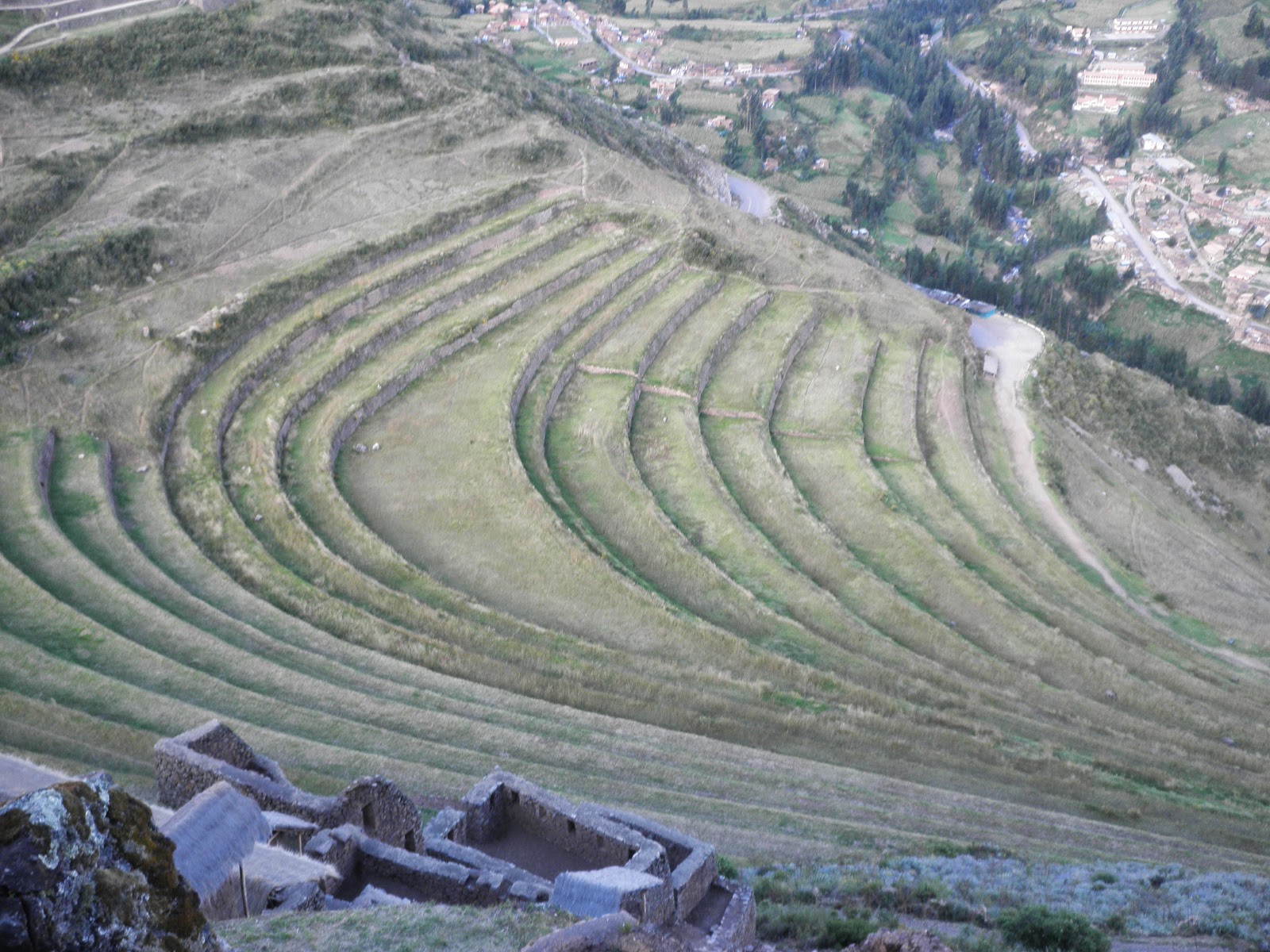
After a one hour drive (during which we all had a siesta), we arrived at Pisac.  Here, we climbed the ruins and learned more about the Inca site and agricultural practices.  The Incas would use the terraces to grow produce, even at a very high elevation.  They did this by introducing things at the lower levels and then slowly raise them up, terrace by terrace.  There were also really splendid views here.  Afterwards, we went to the modern town of Pisac, where we went to the local market and bought things from the vendors.


Once we returned to Yure's house, we packed for the trek (which we start tomorrow!) and headed towards Plaza Mayor to eat dinner at Pucara.  The food was delicious!  We are heading to bed early tonight because we have to be up by 3:30 tomorrow morning!